
Overview of Binance Coin (BNB) on Binance Smart Chain:
Binance Coin (BNB) is the native cryptocurrency of the Binance ecosystem, initially launched on the Binance Chain. However, it has since expanded its utility to the Binance Smart Chain (BSC). Binance Smart Chain is a parallel blockchain to Binance Chain, designed to enable smart contract functionality and decentralized applications (DApps) while maintaining compatibility with the Binance Chain.
Who founded Binance?
Binance was founded by Changpeng Zhao (CZ), who is also known as CZ within the crypto community. He was a prominent figure in the cryptocurrency space and has played a significant role in the growth and development of Binance into one of the largest cryptocurrency exchanges in the world. In November 2023, he resigned due to legal complications and was replaced as CEO by Richard Teng.
Binance's Secret Sauce
One of the main key features of Binance Smart Chain is its compatibility with Ethereum Virtual Machine (EVM). This means that developers can easily migrate their Ethereum-based projects to Binance Smart Chain, enjoying lower transaction fees and faster transaction times while still leveraging the existing Ethereum tooling and infrastructure.
Binance Smart Chain offers other key advantages:
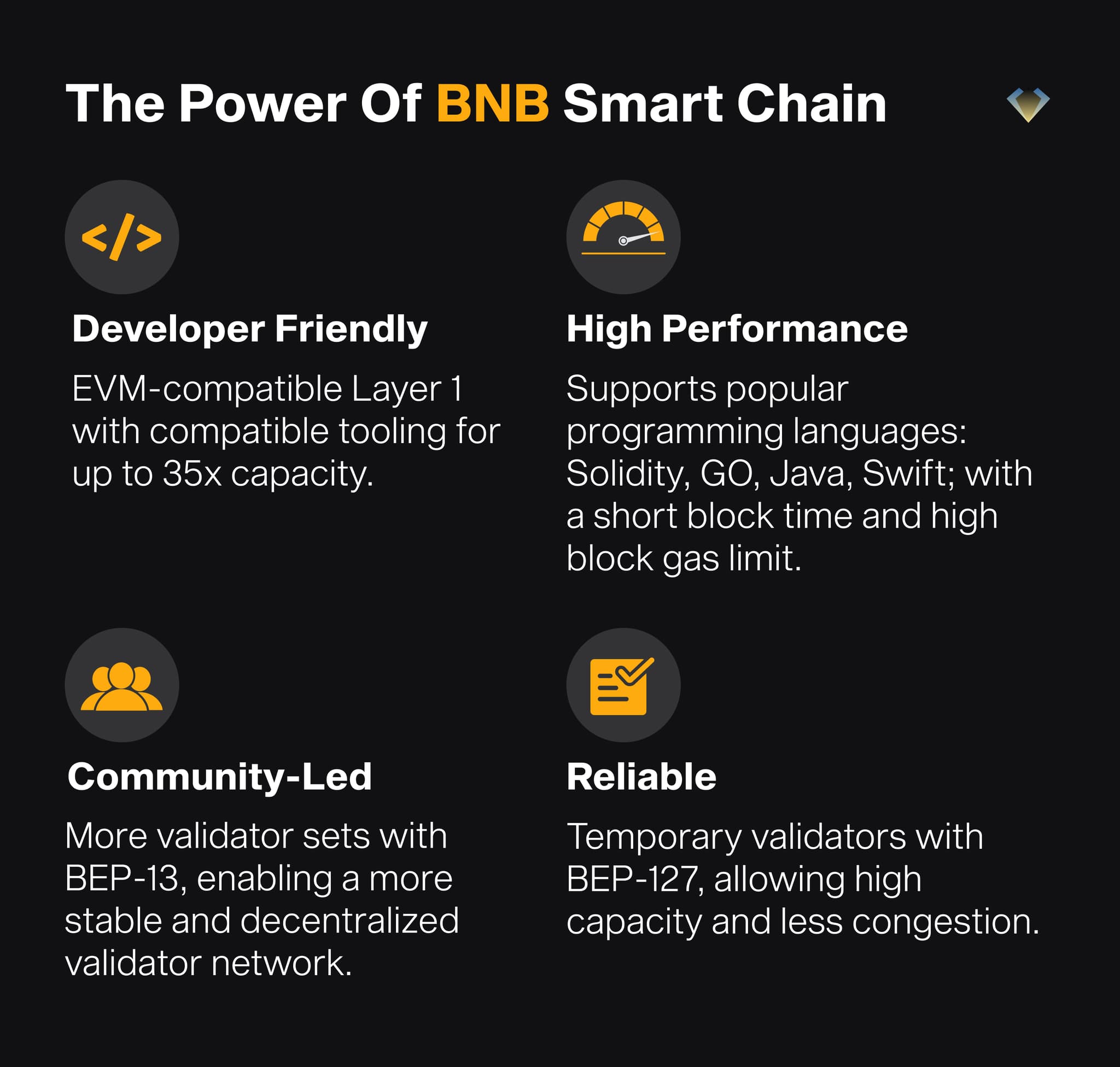
- Developer Friendly: Built on an EVM-compatible Layer 1, Binance Smart Chain accelerates development cycles with up to 35x capacity and compatible tooling.
- High Performance: Supporting Solidity, GO, Java, and Swift, Binance Smart Chain boasts short block times and high block gas limits for swift transactions and efficient resource utilization.
- Community-led: With BEP-13, it promotes decentralization by enabling more validator sets, ensuring network stability and resilience.
- Reliable: Leveraging BEP-127, temporary validators adapt to network demands, reducing congestion and maintaining high capacity for uninterrupted performance.
In essence, Binance Smart Chain provides developers with a seamless transition, high performance, community-driven governance, and reliable operations, fostering innovation in the blockchain space.
Binance Smart Chain Use Cases
1. DeFi (Decentralized Finance) Applications:
Binance Smart Chain has become a popular platform for DeFi applications due to its low transaction fees and high throughput. Users can access various decentralized exchanges, lending platforms, yield farming protocols, and other financial services.
2. Token Offerings and Crowdfunding:
Binance Smart Chain provides an ideal environment for token offerings and crowdfunding campaigns. Projects can launch their tokens, conduct initial coin offerings (ICOs), or raise funds through token sales on the platform.
Tokenomics of Binance Smart Chain
The initial total supply of BNB was 200 million tokens. However, BNB undergoes periodic token burns, reducing the total supply over time. These burns occur quarterly based on trading volumes on the Binance exchange until 100 million BNB remain in circulation.
Buying & Storing BNB Coin on Binance Smart Chain
Buying BNB is easy as it is widely available on centralised exchanges such as Binance, Coinbase, Crypto.com and Kucoin. Read NGRAVE’s guide to how exchanges work to understand the process, costs and risks of buying BNB.
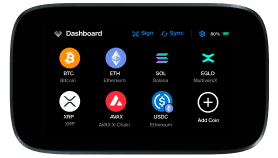
Wherever you choose to buy BNB, the safest place to store it is on an NGRAVE ZERO cold wallet protected from online threats but conveniently accessible for transactions and trading.
Interesting Facts about Binance Smart Chain
1. Binance Smart Chain launched its mainnet in September 2020, quickly gaining traction within the crypto community due to its performance and compatibility features.
2. Binance Smart Chain operates using a Proof of Staked Authority (PoSA) consensus mechanism, which combines elements of both proof of stake and Byzantine Fault Tolerance (BFT) consensus algorithms.
Reality Check
Despite its advantages, there are some considerations for using Binance Smart Chain:
1. Centralization Concerns: Some critics argue that Binance Smart Chain's reliance on a smaller number of validators compared to other blockchains may lead to centralization risks.
2. Dependency on Binance: As Binance Smart Chain is closely associated with the Binance exchange, there could be concerns about over-reliance on a single entity for the operation and governance of the blockchain.
3. Ecosystem Fragmentation: The compatibility with Ethereum Virtual Machine (EVM) may lead to fragmentation within the blockchain ecosystem, as developers may need to choose between Ethereum and Binance Smart Chain or support both platforms simultaneously.
It's important to weigh these factors alongside the benefits when considering whether to use Binance Smart Chain for a particular application or project.