


Structured Decision Making
The biggest challenge of investing in crypto projects is the sheer volume of new and existing coins, protocols, and chains, which you could make a case for putting your money into. The internet is a trove of information, but valuable insight is often buried under a mountain of worthless shilling. There are two general approaches to sorting the signal from the noise.
- Do your own research
- Rely on the research of others
Doing your own research (DYOR) is a core crypto mantra and the only genuine way to justify risking your hard-earned money. Though most people might nod in agreement, the reality is that few have any real clue where to even start.
Acquiring knowledge is not just a slog, requiring endless hours of reading and listening, but a moving target, with new technologies and concepts constantly emerging and being challenged.
The tempting alternative is to outsource this whole DYOR thing to those who shout loudest or most convincingly on social media, but standing on the shoulders of giants is fraught with risk. An Occam’s Razor view of the value of self-proclaimed crypto ‘experts’ is that those who know don’t tell, and those who tell don’t know.
Fortunately, there is a compromise to be made between the unrealistic challenge of re-training as a quant in your spare time and taking massive risks on shilled coins; it hinges on three things:
1. Set yourself a realistic expectation
If you are chasing 100x gains, you are going to be disappointed. Realistic expectations mean you can miss the public sale or the airdrop for early users and not be disappointed. When retail banks are offering less than 0.5% interest on savings, making a 10% return annually puts you way ahead of the game, while doubling your money within a year is a massive win.
2. Focus on things you understand
Warren Buffet is no fan of crypto - he has declared that he wouldn’t pay $25 for the entire Bitcoin supply - but he’s not known as the Sage of Omaha for no reason. One of his golden rules is to only invest in things you understand. This is actually good advice where crypto is concerned.
If your answer is ‘I don’t understand anything about crypto,’ start with some well-regarded essays that make a generalist case for adoption - start with the ‘Bullish Case for Bitcoin’ by Vijay Boyapati.
This should hopefully give you the lightbulb moment and start making connections to things you are familiar with, and which crypto is disrupting. Gaming, exercise, financial services, collectables, property, and privacy, there is a growing list of niches to choose from.
3. Establish a decision-making framework
If you are focused on projects that you understand, you can screen out the noise, reducing the amount of information you have to absorb. This approach will point you in the right direction, but you still need a logical framework to guide your decision-making. That framework should consider two categories of information: quantitative and qualitative.
Quantitative & Qualitative Information
Though these two words may sound a bit intimidating, what they relate to is pretty intuitive. Quantitative information is objectively measurable, so we are talking about decisions based on numbers. Qualitative information is subjective, which means making decisions based on the qualities a project might possess.
We can now draw up a list of the types of categories to include in a framework under the two Qs. The quantitative factors can naturally be ranked, but for the quantitative factors, you’ll need to use a rating system.
What you’ll find is that qualitative factors are more applicable to new projects, because there is no real-world data to measure, while quantitative assessment becomes more relevant once a project is up and running, providing real data that can be tested against competition and expectations.
Qualitative Factors
- Mission & Vision - What problem is it trying to solve?
- Team - What is the quality of the people behind the project?
- Competition - What is the competitive landscape?
- Social & Community - Quality of engagement & buy-in
- Decentralisation & Governance - How is supply & network concentrated?
Quantitative Factors
- Tokenomics - Coin distribution, supply & incentive structure
- Performance - What is the volume and speed of transactions?
- Revenue - How much revenue is generated through fees?
- Addressable Market - How big is the opportunity?
- Social & Community - Number of subscribers & followers
- Network - Number of users, validators & nodes
- Total Value Locked - How much value have users staked in the project?
Subscribe To The NGRAVE Academy
Knowledge for all levels. Join our newsletter to receive the latest articles.
By signing up, you agree to receive our marketing offers following our Privacy Policy. You can unsubscribe at any time.
Mission & Vision
Though crypto throws a lot of the business development and marketing textbooks out of the window, there are still some fundamental truths that hold. Any new project should have a clear sense of Mission as well as a broader Vision for the impact it aspires to in the longer term.
The Mission is a core element of a traditional brand architecture but will likely be part of a crypto Whitepaper. It should only be a few sentences long and communicate clearly what the project does, why it is doing it (normally defining a specific problem it solves) and how it works.
Understanding what a project does should help you understand why its token might have any value. Sustainable projects will grow through network effects and generate revenue from viable tokenomics (both covered below).
If the basis for value creation is cool memes and insane APY, it's unlikely that a project will sustain through a bear market to attain that longer-term Vision.
The Team
As much as the crypto revolution has been made possible by new technologies, a new project is only as good as the team behind it.
The first significant blockchain project may have lacked a named founder but Bitcoin’s sacred launch has become the exception rather than the rule.
The reluctance of founders to put their name to a project can give you a few important flags, most of which are bright red:
- They are worried about the legal repercussions
- They have bad intentions, e.g rug pull
- They don’t want to become a point of weakness for the project, impacting decentralisation
In the worst days of the ICO craze, circa 2017, many projects simply lifted fake profile photos/bios from LinkedIn, so don’t settle for seeing a professional-looking face. Dig into the bios of Founding Teams and look for the following:
- Credibility - What have they achieved before, and how relevant is it to this project?
- Motivation - Does their career suggest they are motivated by curiosity and problem solving or business success?
- Skills - What are the skills focus of the leadership team? If they’re skewed towards business development, marketing, and communication rather than technical abilities, this might suggest style over substance
- Advisors - Projects generally draw on advisors; the willingness of credible advisors, especially academics, to lend their name to a project can be very telling.
Competition
Try and get a sense of the competitive landscape for the particular sector. Does the project have a first-mover advantage? If not first to market, are they faster to market in terms of innovation? How do they intend to win market share? Is their product offer differentiated enough to give them a genuine competitive advantage?
Decentralisation & Governance
Decentralisation isn’t an absolute but more an aspiration which is impossible to objectively measure. Try and get a sense of how important decentralisation is to the success of the project, either in terms of value generation or user adoption, rather than just as an ideal.
Solana is a great example of a crypto project that has grown its user base and market cap despite suffering significant outages a few years ago, which fundamentally questioned its decentralisation. As an investor, you should consider what matters to users and how they respond to issues.
Solana is still a prime example of a project that grew its user base and market cap despite early concerns around centralisation. From 2021–2022, network outages raised serious questions about validator concentration and reliability. However, the network has rebounded impressively. By 2025, Solana boasts improved uptime, growing validator distribution (see validator stats), and thriving consumer applications like DRiP, Helium, and Jupiter.
The takeaway: users often prioritize performance and cost-efficiency over decentralisation—until a crisis makes them rethink.
Governance is about how decisions are made and who controls the direction of a project. It becomes critical as protocols mature and amass treasuries, user bases, and ecosystems. Arbitrum DAO is now one of the most active DAOs (Decentralized Autonomous Organization), managing over $3B in assets and funding hundreds of ecosystem projects through Arbitrum Grants. Its transparent proposal and voting structure illustrates governance at scale.
Meanwhile, Optimism is pioneering a dual governance model with a Token House and Citizens’ House, using retroactive public goods funding (RetroPGF) to reward developers after they've delivered impact.
These projects show that progressive governance can become a competitive edge, attracting builders and users who value transparent resource allocation and long-term alignment.
However, a more recent cautionary tale is ZKasino, a project that marketed itself as decentralized but in reality was heavily centralised. In 2024, over $30 million in user funds were reportedly rerouted to a team-controlled wallet without consent. The resulting backlash, investigations, and loss of trust served as a stark reminder: without transparency and proper governance, even promising projects can collapse overnight.
A good yardstick for progressive governance is where the motivations of owners and users overlap rather than conflict. Look for projects where governance is transparent, incentives are public, and decisions are made with the community, not behind closed doors.
Related Articles:
Social & Community Presence
Crypto projects rip up traditional approaches taken by businesses to acquire new customers, with the role of Social Media and Community central to success. But bootstrapping projects solely through organic growth is rare, so you need to be careful to distinguish genuine organic growth in Social and Community channels from growth that has been acquired, incentivised, or generated by bots.
What we mean when we talk about Social Media are short-message platforms like Facebook, Twitter, TikTok, and Telegram; Community generally refers to forums like Reddit and Discord.
It helps to understand that these platforms are naturally indexed toward certain demographic groups which can tell about the user base projects are attracting and if that aligns with expectations for growth.
The nature of Social and Community, with known followers and subscribers, provides plenty of quantifiable data you can use to measure their significance to a crypto project. If you are technically minded you can even access data via API with some services doing sentiment analysis of Social Media channels and forums.
In quantifying Social and Community audiences you shouldn’t conflate followers and subscribers, who are only committing attention, with actual users, who are risking their money; otherwise known as skin in the game.
Here’s a summary of the useful things that Social and Community can tell you including both quantitative and qualitative aspects.
Quantitative
- Total number of followers, subscribers
- The rate of audience growth
- How active is the audience? What is the engagement rate per subscriber/follower?
- What are the participation rates for DAO votes?
Qualitative
- What is the general sentiment? Hopium vs realistic?
- Are there a lot of technical/usability complaints and how are they addressed?
- How consistent and professional are official posts, AMAs and Community updates? Are they stage-managed to avoid hard questions or genuine forums for debate?
- Is the community vibrant and creative or stagnant, superficial or impatient for price appreciation?
Tokenomics
Aside from thinking about the subjective utility of a crypto project, you need to consider the specific mechanics of the representation of that value - the token/coin - and how it is created and distributed. This is known as tokenomics.
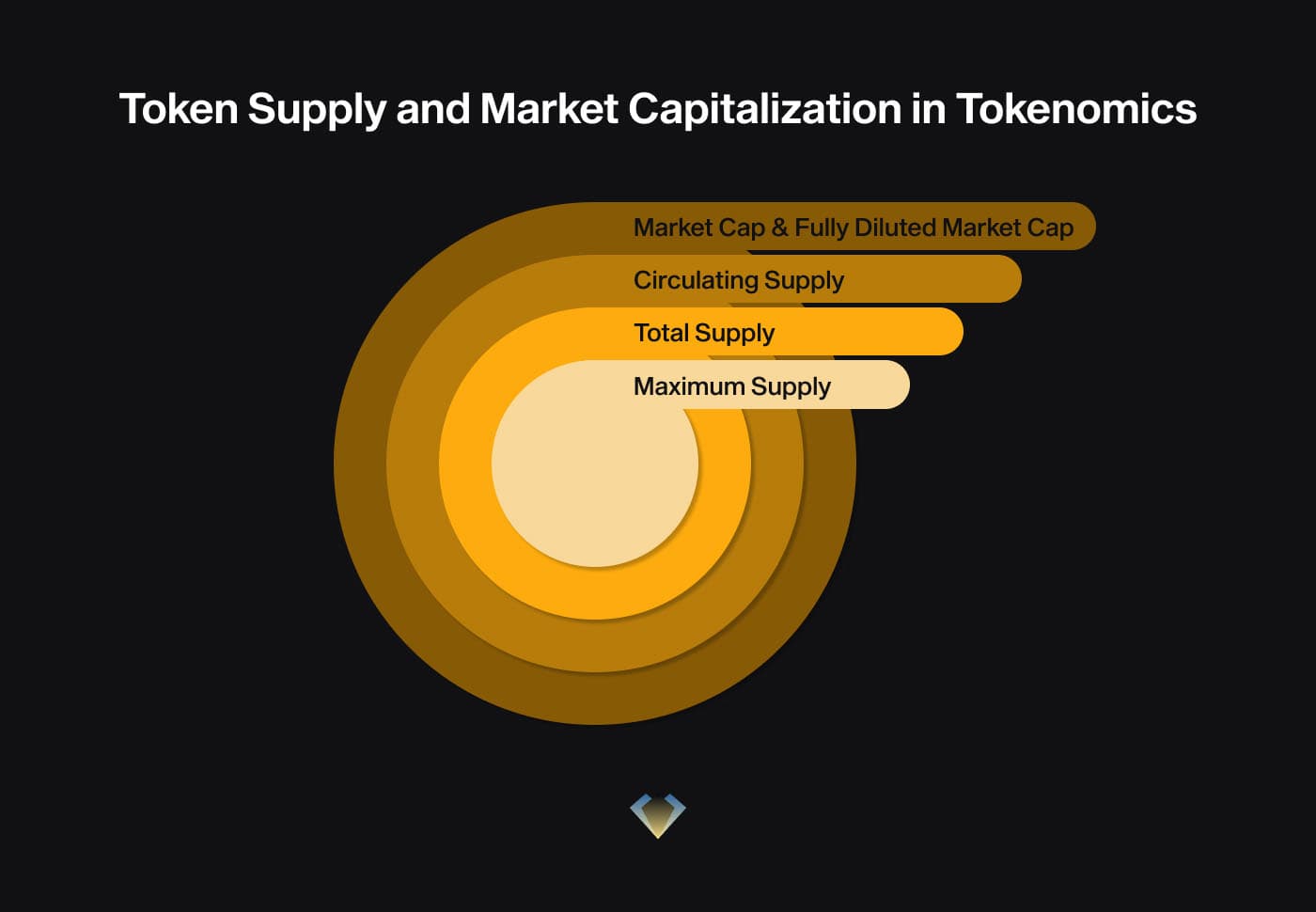
Token/coin supply is the key component of tokenomics and can be measured in a few key ways:
- Maximum Supply - This represents an explicit cap on the total number of coins/tokens that will ever exist and will tell you whether the token supply is inflationary or deflationary, which has a huge bearing on potential value.
- Total Supply - The total number of coins that have been created up today, but aren’t necessarily spendable, potentially because they are lost or burned.
- Circulating Supply - An estimate of the total number of circulating coins, i.e spendable coins. This is a subset of Total Supply, because it accounts for coins that are lost or burned.
- Market Capitalisation - Market Cap is one of the most referenced metrics for measuring the overall value of a cryptocurrency. It is calculated by multiplying the Circulating Supply by the current price. Market Cap is more meaningful than price because it factors in supply. A coin might have a low nominal price but an insanely high supply. Any expectation that Market Cap will increase would require a corresponding increase in supply, absent any other influencing factors.
It is a mistake, however, to see Market Cap as a proxy measure for value. Though it is helpful in a comparative sense, on its own, it doesn’t tell you much about what a cryptocurrency is worth. It simply reflects what the last person was prepared to pay.
- Fully Diluted Market Capitalisation - A projected value based on the Maximum Supply, but at the current price.
Though external comparison can be useful, much of crypto is so unique that value is measured in terms of itself, comparing the market cap of similar projects. Websites have emerged to help understand how much the price of a coin may have to increase to match the market cap of a comparable project. This can put unrealistic expectations into perspective.
Performance & Scalability
When blockchain-based systems are compared to each other and to traditional financial networks, like Visa, the most often quoted metrics are the volume and speed of transactions, generally referred to as TPS (Transactions Per Second). This data is a great point of reference, but shouldn’t be considered the knock-out blow.
So-called Ethereum killers, like Avalanche and Solana, use different consensus mechanisms to deliver better performance, with the promise of scale but often by compromising on decentralisation. Squaring those three qualities is known as the blockchain trilemma. Your job is to gauge what users will value most.
Different approaches to performance and scalability are constantly being developed with a lot of focus on layer 2 applications, especially within the Ethereum ecosystem, where rollups promise significantly faster transactions and considerably lower fees, which brings us to revenue generation.
Revenue
If you watch programs like Shark Tank or Dragon’s Den, where entrepreneurs are quizzed about their business ideas, the panel always wants to know about revenue - how much money is coming in, and what are future income projections.
Crypto projects aren’t like traditional businesses in terms of revenue and cash flow, but fee generation is the closest analogue. There are plenty of websites that will show you how much protocols are earning in fees, just bear in mind that there is a tension between users wanting low fees and coin holders wanting high fee revenue.
The scenario that benefits both is high performance and low fees, along with tokenomics that doesn’t erode value through inflation.
TVL - Total Value Locked
TVL is the strongest indicator that the tokenomics and fee structure of a project is sound because it reflects the aggregate value that users have locked up in the project in return for yield.
You can use dashboards like DefiLlama to filter projects by TVL. At the time of writing, Ethereum has over $51,000bn TVL which represents more than 50% of the value locked across all chains. This reflects confidence in the upcoming Merge which will Ethereum to a Proof of Stake chain, increase performance, make it more environmentally friendly and the burning of fees will see it move to a deflationary issuance model.
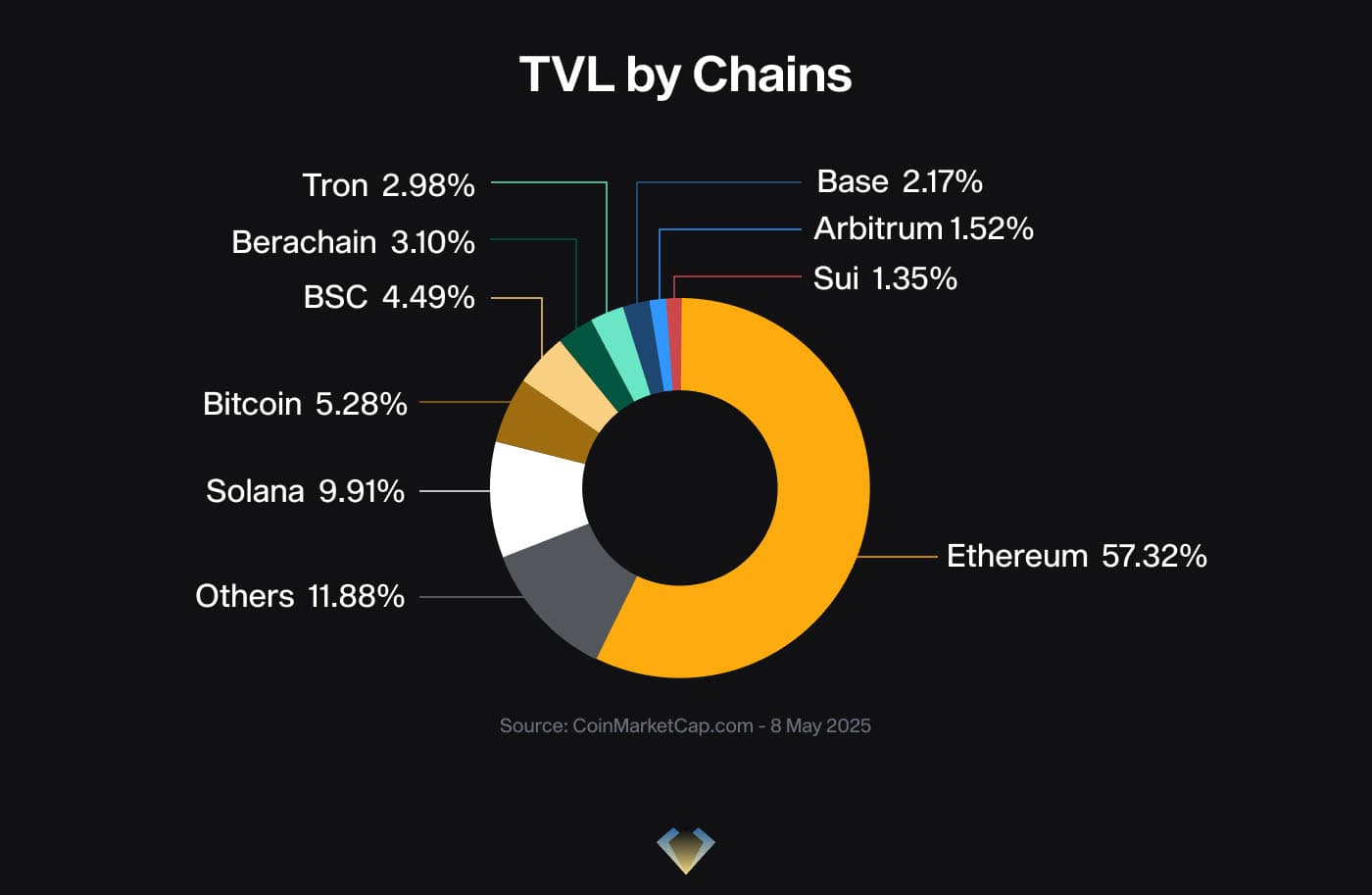
As of 2025, Ethereum remains the dominant smart contract platform with over $45 billion in TVL, accounting for approximately 55% of all value locked across chains. This continued dominance reflects strong developer activity, ecosystem maturity, and the successful implementation of upgrades like The Merge (completed in 2022) and EIP-4844 (Proto-Danksharding), which significantly reduced Layer 2 fees. Combined with its deflationary issuance model (via EIP-1559 fee burning), Ethereum has cemented its position as the most trusted base layer in decentralized finance.
Addressable Market
This quantitative metric is fairly straightforward. Once you know the problem the project solves, you want to know how many people are crying out for the solution. The addressable market is usually discussed in terms of a penetration rate, which is the % of that total market the project is expected to be able to capture. The addressable market should factor in competition, and other dynamic factors like changes in demographics, macroeconomics and changes in general technology adoption (like smartphones and broadband).
Given that blockchain ecosystems are built in layers, Layer 2 solutions—such as Optimism, Arbitrum, and Base—naturally benefit from the network effects of Ethereum’s expanding ecosystem, which serves as their foundational layer. This inherited network strength acts as a proxy for their addressable market, accelerating user adoption and developer activity. Their reach is further amplified by cross-chain bridges, interoperability protocols, and centralized exchange listings, all of which make it easier for users to access apps, assets, and liquidity across networks.
Network
Though crypto is hard to measure through traditional business metrics, the open-source nature of blockchains provides a huge amount of useful data to measure the health of the Network. Some of the main stats to look for include:
- Active Users/Addresses
- Number of Validators
- Hashrate for Proof of Work chains
- Block confirmation time
- Transaction volume & size
How to find good projects?
Establishing a simple framework to rate and rank key characteristics of crypto projects will definitely help your decision making but what you probably want to know is how to even find them in the first place. Here are some ideas:
- Curate a list of people and topics to follow on social media that provide reasoned analysis rather than dramatic predictions without any basis
- Use tools that can do the heavy lifting of analysis for you. Platforms like DefiLlama offer real-time dashboards for tracking TVL, protocol revenue, and cross-chain activity. CryptoStats provides open-source, community-maintained data visualizations for comparing project fundamentals. For deeper insights, services like Messari offer professional-grade reports, token breakdowns, and ecosystem trends—all useful for investors who want to go beyond surface-level hype.
- Create daily Google alerts based on relevant keywords, projects, or people.
- Join selected Sub-Reddits, Discord Channels, and Telegram groups that provide useful information; leave those that are distracting or unhelpful.
- Group together with like-minded friends to pool resources and hunt down promising projects to assess
A checklist for crypto investing
We can condense our suggested approach to finding investable crypto projects into a checklist to keep you honest:
- Build and nurture an information network for surfacing promising projects
- Decide what success looks like. Once you’ve set realistic returns, commit to realising profit at that point, rather than expecting the number to go up forever.
- What does failure look like? Are you prepared to let the price go to zero, or have a stop-loss in mind?
- Stick to projects you understand and could coherently explain to someone who has no clue about crypto.
- Build a framework for rating projects based on qualitative and quantitative data that you can realistically apply and use.
Subscribe To The NGRAVE Academy
Knowledge for all levels. Join our newsletter to receive the latest articles.
By signing up, you agree to receive our marketing offers following our Privacy Policy. You can unsubscribe at any time.