


Understanding the risks of crypto investment
When you look at the long-term gains from Bitcoin - considered crypto’s blue chip - it isn’t hard to see why investors are allocating savings to crypto.
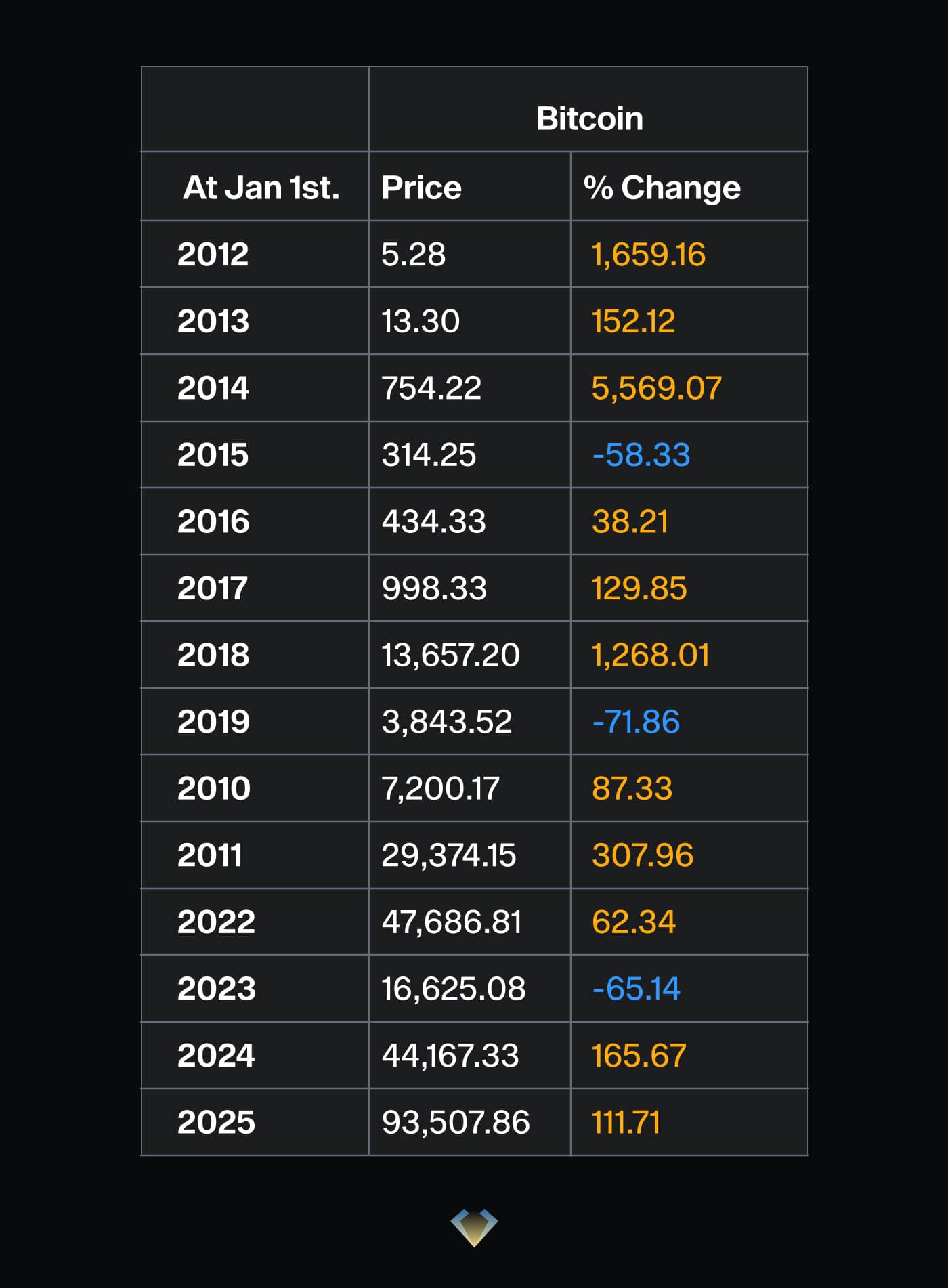
Past success doesn’t, however, guarantee future success and long-term gains hide extreme short-term volatility, so any crypto savings strategy must have a clear appreciation of risk.
Of course, it is impossible to quantify the specific risk of investing in cryptocurrencies with any certainty - and anyone who tells you otherwise should be treated with extreme caution - but crypto investing shouldn’t be about fear, but empowerment, and that only comes from educating yourself. It is a mistake to simply outsource decision making, by blindly following social media, forum posts, or even articles like this.
Developing a conviction takes time and effort to learn, but given the risks to your hard-earned money, you should be willing to do your own research. In fact, DYOR is one of the most important pieces of crypto investment advice you can learn.
Sophisticated investors will employ a number of recognised approaches:
- Fundamental analysis - analysing long-term adoption trends
- Technical analysis - interpreting price movement, chart patterns & trading volume
- On-chain analysis - interpreting blockchain transaction data & analysing segment behaviour
None of these can be learned overnight, but of the three, gaining a fundamental understanding of what you are investing in, is the most sensible starting point, and aligns with long-term expectations, rather than dramatic overnight gains.
Regardless of the methods you choose to try to quantify the risks involved, the next golden rule of any crypto investment strategy should be to only commit funds you can afford to lose. That might sound at odds with the image of Lambo driving overnight crypto millionaires, but in reality, those are the exception, not the rule.
Subscribe To The NGRAVE Academy
Knowledge for all levels. Join our newsletter to receive the latest articles.
By signing up, you agree to receive our marketing offers following our Privacy Policy. You can unsubscribe at any time.
The key phrase to understand when deciding how much to invest is something called discretionary income. This is the amount of income you have left over after all your fixed monthly commitments have been accounted for. This must be money you can afford to lose and does not incur debts, or have any material impact on the essentials of your day-to-day living.
You should only consider investing from your discretionary income, savings, or inheritance; as a new crypto investor, you shouldn’t take on debt or leverage. Even with those investable funds established, you should consider crypto as one element in what is known as a balanced portfolio.
What is a balanced portfolio?
Though the risk is hard to put a number on, there are some general categorisations in traditional investment - we can call TradFi - that sit on a spectrum.
- Low risk will include fixed-income products like savings accounts, pensions, or bonds, which normally have a lock-up period.
- Medium risk might include index-linked funds or blue chip shares/stocks
- High risk might include investing in start-ups, low-cap stocks (penny shares) & crypto.
The idea is to allocate your discretionary income in inverse proportion to the risk; so the bulk of your investment would be in low risk. This is, however, just a framework that can be adjusted based on your age/objectives, so long as you are only investing from discretionary income/savings.
The younger you are, the greater your risk appetite, as you have greater future earning capacity, so your higher risk bucket will be bigger. There is an obvious contradiction in keeping a proportion of your funds in fiat, and some in crypto, given the latter is billed as the replacement of the former, but you can consider it to be sensible diversification.
Yoloing everything into crypto requires a significant amount of conviction, backed by an appropriate amount of research, so most novice investors will have a foot in both camps, adjusting the balance over time.
This balanced portfolio approach is also fractal, which means that you can take the crypto portion of your savings, and apply a similar risk spectrum within it, which not only applies to the types of crypto you might invest in, but the strategies used and the method of storage.
The last element is unique to crypto as it is a decentralised financial asset where you are directly responsible for your funds, and the way you store them. The table below introduces some strategy and storage combinations, with increasing levels of risk.
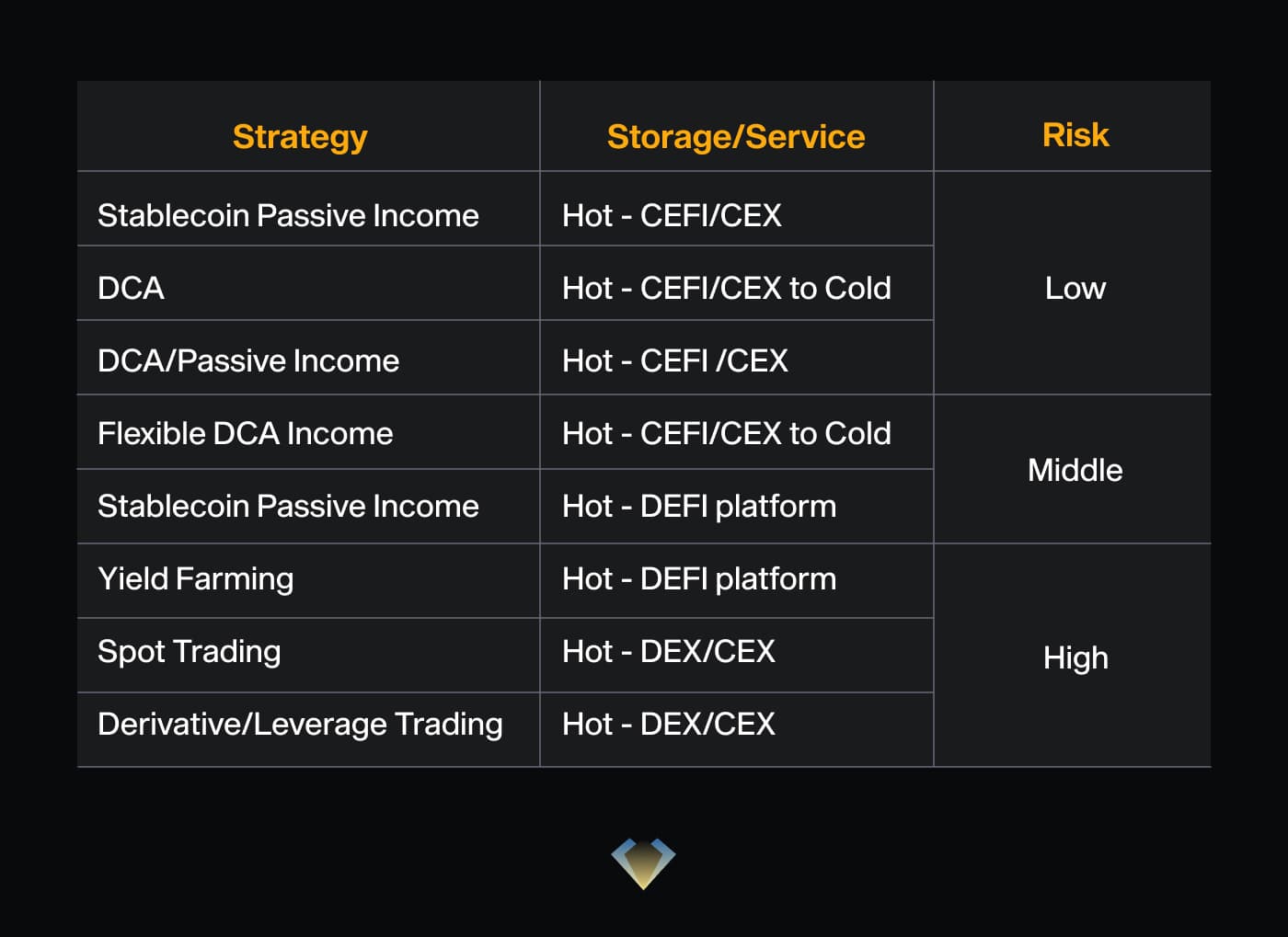
Stablecoin Passive Income
One of the simplest crypto investment strategies, that involves a relatively easy transition from Tradfi approaches, is to simply convert discretionary income/savings into a Stablecoin.
Stablecoins are crypto versions of existing fiat money, with a mechanism to retain a value pegged to the traditional version. Examples are USDT (Tether) or USDC, though there are versions for most major currencies.
The big attraction here is the significantly higher interest rates available for Stablecoins. Why is this? Rates reflect borrowing demand, and given crypto traders prefer to trade in and out of stable base currency, that demand is high.
This isn’t, however, free money because there are two areas of counterparty risk. Firstly, the Stablecoins themselves could collapse. They aren’t insured, nor do they have any connection to the fiat equivalent.
There is a huge amount of speculation around the different mechanisms used by Stablecoins to retain their peg, and whether every synthetic dollar created is actually backed by a real dollar (just google ‘Tether ponzi’ to learn more).
Secondly, to gain interest, you have to hold your funds with a specific service provider, such as a CEFI(Centralised Finance) Platform - also known as a crypto bank - a crypto exchange or a DEFI (Decentralised Finance) Platform.
Each of these comes with their own level of counterparty risk, and they are all Hot Wallet services; in other words, you have to be online to use them, which puts your crypto funds at risk to online threats.
Cost Averaging Strategy
Having done your research, you may feel that the Stablecoin option doesn’t have enough upside, and therefore look to invest a proportion of your portfolio in pure crypto assets - such as Bitcoin and Ethereum - which are volatile, but considered blue chips based on their price history.
You now face the difficult task of choosing the right time to pull the trigger on your first investment, which given short-term volatility, is no easy challenge.
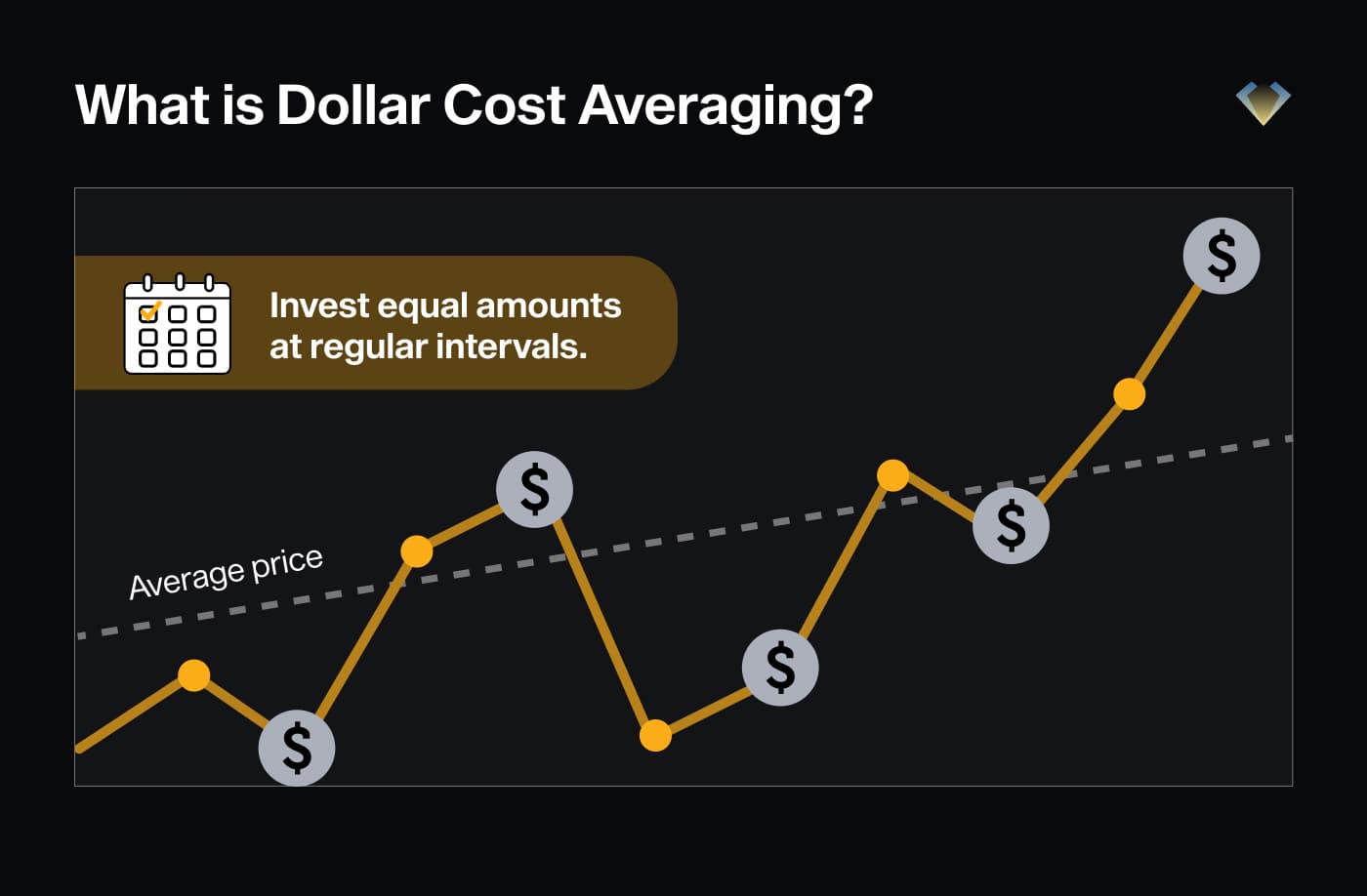
Interpreting short-term market behaviour isn’t an exact science. There are many schools of thought around what exactly drives short-term price movement, mostly focusing on varying techniques and tactics within the area of technical analysis introduced earlier.
It is totally unrealistic for you, as a novice crypto investor, to wrap your head around those concepts, but luckily there is a sensible and simple crypto savings strategy to get you started, called Cost Averaging - sometimes Dollar Cost Averaging, or DCA for short.
Cost Averaging simply means making regular, recurring purchases of equal value spread over time, instead of one lump sum investment.
This approach allows you to average out the short-term volatility, and if your overall premise is correct, build a net-positive investment over time.
The benefits of Cost Averaging
- A simple strategy that can be automated at most exchanges
- Removes the stress & uncertainty of timing purchases
- Has proven successful in the long run for Bitcoin & Ethereum
- Allows you time to learn as your investment grows
- Doesn’t require an initial lump sum
The downside of Cost Averaging
- Works best when pursued through a Bear Market and into a Bull Market
- Recurring purchases will incur more transaction/trading fees
- Requires patience & discipline as takes time to build a meaningful position
- Doesn’t guarantee success
Cost Averaging isn’t a magic bullet for successful crypto investing, but it is the most sensible approach for someone without experience, and with modest discretionary income. It is a really good idea to build a Cost Averaging tracker - in Excel or Google Sheets but kept offline - to both give you a clear picture of your profit and loss, as well as keep you grounded.
However, given you need a cryptocurrency exchange to fulfill the buying function, there will always be the temptation to follow short-term impulse trades.
Cold Storage - the antidote to impulse trading
Cost Averaging is sensible for inexperienced investors, because it simplifies what can be a complex decision-making process, and enforces a level of self-control.
If you leave your funds on the exchange you use to facilitate the recurring purchases, you could be tempted to abandon your plan when the rollercoaster ride is at its most extreme, trying to catch a short-term spike or bail out when the price plummets.
Those are the moments when your patience will be tested to the max, and it helps if you take an out-of-sight, out-of-mind approach, by moving your funds after each recurring purchase into what is known as Cold Storage.
Cold Storage means placing your crypto assets in a completely offline state, safe from any malicious online threats, but with the additional benefit of making it less likely that you’ll make a hasty trading decision.
The recommended form of Cold Storage is a cryptocurrency hardware wallet, which is what NGRAVE manufactures, so we have a huge amount of additional resources to help you understand their benefits and function.
Related Articles:
It is sensible to start with Cost Averaging and Cold Storage combination because it enforces patience and gives you a grounding in moving your crypto around - from the exchange to your hardware wallet.
Cost Averaging & CEFI
One popular bolt-on to Cost Averaging is to send the funds to a CEFI provider and earn a passive income on your growing crypto portfolio, instead of sending it all to cold storage,
Though this also removes any temptation of impulse trading, it introduces the same counterparty risks described above in relation to generating passive income from Stablecoins. You have to weigh up the benefits of single-digit APR against the potential loss of all your funds if the CEFI provider goes belly up, or your account is compromised.
Flexible Cost-Averaging Strategies
As you build up your knowledge and experience over time, you can also modify the rigid recurring Cost Averaging approach, either by building up an understanding of technical analysis, or using existing models (such as Plan B’s Stock-to-flow) to adjust the size of each purchase.
Think of it like taking off the rails at the bowling alley. You retain the regularity of purchases but start to introduce subjective analysis of the state of the market, reducing amounts when the market seems overbought, and the reverse when oversold.
This approach may work best when using one indicator to begin with - such as Relative Strength Index (RSI) or Moving Averages - which you have researched and understood.
This doesn’t however, have to be where crypto savings strategy ends, as you gain knowledge and experience, you can adjust the risk balance and layer Cost Averaging with other, higher risk opportunities.
It would be sensible to maintain the largest proportion in the safety of cold storage - think of that as your crypto savings - and allocate the remainder to higher risk strategies, that require interaction via hot wallets. The combination of the security of NGRAVE’s ZERO and companion software - LIQUID - through QR codes, means that you can remove the distinction between portions of your portfolio kept in hot/cold storage, we even offer direct Metamask and Rabby Wallet integrations.
Taking something off the table
The true benefits of cost averaging are felt over the long run, especially through a Bear Market (when prices are depressed for a significant time) but if, and when, your portfolio is in a healthy profit, the recurring purchase approach can work in reverse. You can create parameters to guide you in selling fixed amounts at regular intervals, which might include setting:
- Rake - the proportion to sell e.g 10%
- Trigger - the level of price increase that triggers the sale e.g 50% increase
- Cycle - the number of times you’ll follow the trigger e.g five times
Be realistic with your parameters; 10 cycles of 50% increase would require a coin to see a x57 increase. That isn’t unheard of, but is nevertheless, a significant level of appreciation.
Understand time preference
Once you start adapting a Cost Averaging strategy you are really moving from a passive, savings approach, to something closer to active trading, which increases the temptation to be constantly engaged in the market.
Some people have the discipline and mindset to make active trading work, but for most, it really isn’t suitable, and recognising that can be one of the best decisions you might make.
Over its relatively short existence, crypto has benefited those investors who have what is known as a low-time preference, which is the ability to defer gratification to some point in the future. This is what the HODL meme represents.
It can be gratifying to correctly read the market, and the volatility of crypto certainly provides endless opportunities to try and buy the dip, but you equally run the risk of getting completely rekt. Social media and forums are full of trader war stories lamenting the wish to have simply left their stack alone.
Though we disagree with Warren Buffett’s famous description of Bitcoin as rat poison squared, he’s not a billionaire for nothing. If you want a sensible crypto savings strategy, take a leaf out of the Sage of Omaha’s investing book, and simply play the long game.